Answer engine optimization is the practice of structuring content so AI systems can extract, trust, and cite it when generating responses to user queries.
If you work in the AI industry and your content is not appearing in ChatGPT, Perplexity, or Google AI Overviews, you are invisible to the buyers who matter most.
Gartner projects that AI chatbots will reduce traditional organic search volume by 25% by 2026. The shift is not coming. It is already here.
This guide covers how AI citation actually works at a technical level, what structural practices increase your probability of being cited, and how to measure whether your AEO efforts are working.
Key Answers at a Glance
What is AEO? It is the discipline of making content extractable and citable by AI answer engines, not just rankable in traditional search.
Why does AI skip content? AI retrieves by semantic chunk, not by page rank. Poorly structured paragraphs get skipped regardless of domain authority.
What structure does AI prefer? Direct answers in the first 50 words, one idea per paragraph, question-based headings, and standalone extractable blocks.
How do topic clusters help? They map to query fanout, the sub-queries AI runs internally, which multiplies your citation surface across a single response.
How do you measure AEO? Track AI referral traffic in GA4, monitor brand mentions across LLMs, and measure share of citation versus competitors.
What Is Answer Engine Optimization and Why Does the AI Industry Need It Now?
Answer engine optimization is the discipline of structuring content so that AI-powered systems select it as a cited source when generating answers. It goes beyond traditional SEO because the goal is not a ranking position. It is a citation inside a synthesized response.
For companies in the AI industry, this distinction is urgent. Your buyers are researchers, founders, and product leaders who use ChatGPT and Perplexity as their primary research tools. They do not browse page two of Google results. They ask an AI and act on what it says.
AEO and traditional SEO share foundations but serve different outcomes. SEO gets your page into a list of ten blue links. AEO gets your brand cited inside the answer a buyer reads before they ever click anything.
| Signal | Traditional SEO | Answer Engine Optimization |
| Primary goal | Rank in search results | Get cited in AI responses |
| Success metric | Organic traffic and rankings | AI citations and brand mentions |
| Content format | Comprehensive long-form pages | Chunked, extractable answer blocks |
| User behavior | Keyword search, click, browse | Conversational query, read AI answer |
| Competitive unit | Page authority and backlinks | Citation frequency and entity clarity |
The two disciplines are not in conflict. Strong SEO remains the foundation that AI systems build on. But AEO adds a structural layer that SEO alone cannot provide.
Why Does AI Skip Your Content Even When You Rank on Google?
A page ranking number one on Google can receive zero citations from ChatGPT or Perplexity. This is not a bug. It is the result of a fundamentally different retrieval mechanism.
A Semrush 2024 study found that only 20 to 26 percent of pages appearing in top organic results also appear in Google AI Overviews. Ranking and citation are two separate competitions with two separate criteria.
The reason is structure. Traditional SEO rewards pages that cover a topic comprehensively. AI retrieval rewards paragraphs that answer a specific question completely, in isolation, without context from surrounding text.
The Chunk-Level Extraction Problem
AI systems do not read your article the way a human does. They break content into semantic chunks: individual paragraphs or sections. It evaluates each chunk independently against the user’s query.
A paragraph that begins with ‘As we discussed above’ or ‘Building on that point’ fails AI extraction. The AI has no ‘above.’ It pulls the paragraph alone and evaluates whether it is a complete, standalone answer.
This means one weak paragraph inside an otherwise excellent article can reduce your citation probability. And one strong paragraph inside an average article can get your brand cited.
Why Keyword-Optimized Content Fails AI Retrieval
Traditional keyword optimization targets lexical match: using the right words in the right density. AI retrieval uses semantic matching: comparing meaning through vector embeddings, not word frequency.
A page optimized for ‘answer engine optimization best practices’ may never appear in AI results for ‘how do I get my content cited by ChatGPT’ — even though both queries point to the same topic. The semantic gap is real.
AEO closes that gap by writing content that answers the underlying question directly, not content that targets the surface-level keyword.
How Does AI Actually Decide Which Content to Cite?
AI citation is not random and it is not purely a function of domain authority. Large language models using Retrieval-Augmented Generation (RAG) select sources based on three specific engineering criteria.
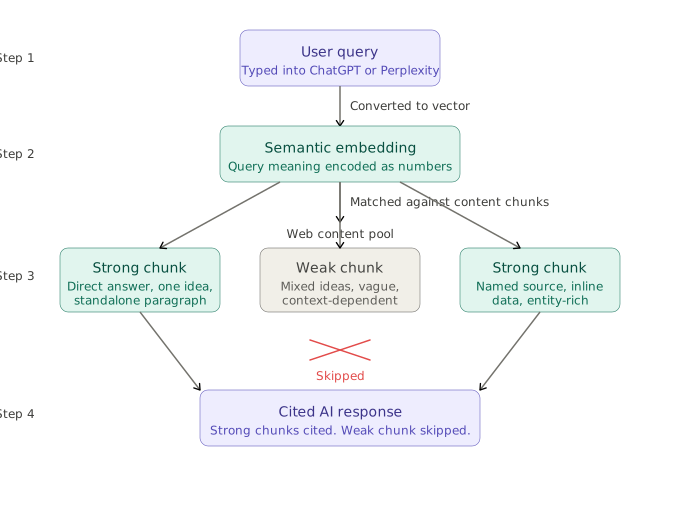
RAG is the technical architecture behind how ChatGPT Search, Perplexity, Google AI Overviews, and Microsoft Copilot retrieve external content. Understanding it is the prerequisite to optimizing for it.
| RAG Criterion | What It Means | How to Optimize For It |
| Semantic relevance | Content meaning matches query meaning via vector embeddings | Write direct answers to specific questions, not broad coverage of topics |
| Structural clarity | Content is organized in machine-parsable blocks | One idea per paragraph, question-based headings, 50-word answer blocks |
| Entity validation | Brand and claims are consistent across multiple trusted sources | Maintain consistent entity information across web profiles, citations, and content |
Most AEO guides skip the RAG explanation entirely. They give formatting advice without explaining why the formatting matters. The reason is semantic chunk retrieval, and that mechanism is what every structural recommendation below is designed to serve.
Perplexity averages 6.6 citations per response. ChatGPT averages 2.6 citations per response, according to xFunnel AI 2025 research. The platform you target shapes how many citation opportunities exist per query.
What Content Structure Makes AI Stop and Cite You?
Extraction-ready content is not the same as well-written content. A beautifully written essay with flowing narrative is harder for AI to cite than a clearly structured answer block that stands alone.
The goal is not to write for machines at the expense of humans. It is to write in a structure that works for both: direct enough for AI to extract, clear enough for humans to trust.
The Direct Answer Block
Every section of your content must open with a direct answer to what the heading promises. Not a build-up. Not context-setting. The answer first, then the explanation.
The first 50 words of every section carry disproportionate citation weight. Discovered Labs analysis found that approximately 44 percent of ChatGPT citations originate from the first third of a page’s content.
If your answer is buried in paragraph four, AI never reaches it.
The One-Idea-Per-Paragraph Rule
Each paragraph must contain exactly one complete idea. Nothing more. This is the rule most content teams violate and the one that most directly reduces citation probability.
When a paragraph mixes a definition, a statistic, an example, and a recommendation, AI cannot cleanly extract any of them. It moves on to a source that separates those elements.
Split ruthlessly. One definition paragraph. One statistic paragraph with source named inline. One example paragraph. Each is independently citable. Each is independently extractable.
Question-Based Headings
Headings formatted as questions align directly with how users prompt AI tools. A heading that reads ‘How does AI select sources?’ matches the semantic pattern of a real conversational query.
A heading that reads ‘Source Selection Methodology’ does not. AI sees a label. The question heading gives AI a query-answer pair it can extract as a unit.
How Do Topic Clusters Multiply Your AI Citations?
Building topic clusters is standard SEO advice. But the mechanism that makes clusters work for AEO is different from why they work for traditional search. Most guides never explain it.
The mechanism is query fanout. When a user asks ‘what are the best AEO practices,’ AI does not just process that single query. It internally generates and searches multiple related sub-queries to build a comprehensive response.
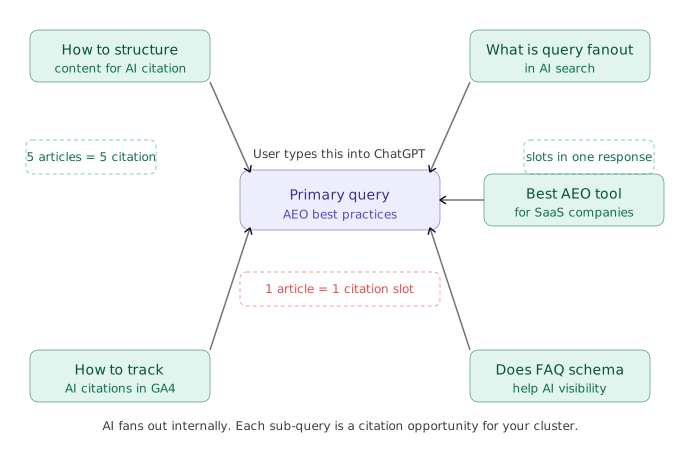
Those internal sub-queries might include: how do I structure content for AI citation, what is query fanout in AI search, how does FAQ schema help AI visibility, and how do I track AI citations in GA4.
If you have one article on AEO best practices, you can only appear in the primary retrieval. But if you have individual articles mapped to each likely sub-query, your brand can appear multiple times inside a single AI-generated response.
This is exactly how Rankability earned two separate citations inside a single Google AI Mode answer: two aligned assets, not just one.
| Primary Query | Likely Fanout Sub-Query | Asset Needed |
| Best AEO practices | How to structure content for AI citation | Dedicated article on content structure |
| Best AEO practices | What is query fanout in AI search | Dedicated article on query fanout |
| Best AEO practices | How to track AI citations | Dedicated article on AEO measurement |
| Best AEO practices | Does FAQ schema help AI visibility | Dedicated article on FAQ schema for AEO |
| Best AEO practices | AEO tool for SaaS companies | Comparison or product-led article |
One article competes for one citation. A cluster competes for every sub-query AI runs internally when processing your primary topic. That is the compounding advantage clusters create in AI search.
Which Trust Signals Actually Trigger AI Citation?
E-E-A-T is a Google framework. But the signals that trigger AI citation operate at a more specific level. Understanding which signals matter in RAG retrieval is different from understanding what Google’s quality raters look for.
AI systems use entity consistency as a validation mechanism. If your brand name, product descriptions, and founder credentials appear differently across your website, LinkedIn, G2, and press coverage, AI systems treat this inconsistency as a reliability signal against you.
Original Data and First-Party Research
AI systems prioritize content containing information they cannot find elsewhere. Original research, proprietary frameworks, internal case studies, and first-party data are weighted higher in RAG retrieval because they represent unique information gain.
Generic rewritten content duplicates what AI already has access to. It contributes nothing to the retrieval pool. Original data does.
One original insight, whether a framework you developed, a dataset you collected, or a case study from your own clients, can anchor your citation position across an entire topic cluster.
Inline Source Citations
AI engines trust content that cites its own sources. Articles containing inline citations to research studies, government data, and industry reports score higher in the RAG retrieval process, according to Frase’s 2026 AEO analysis.
This is not about adding a references section at the bottom. It is about naming the source inside the sentence where the claim appears. ‘According to Gartner’s 2025 projection’ is a citation. ‘Studies show’ is not.
Named Entity Consistency
Define your brand, product, and team as recognizable entities. Keep those definitions consistent across every surface where AI might encounter them. Your website, LinkedIn company page, G2 profile, Crunchbase listing, and any press mentions should describe your product the same way.
Inconsistent entity signals force AI to lower its confidence before citing you. Consistent entity signals accelerate citation probability across every platform that uses RAG.
How Do You Know If AI Is Actually Citing You?
Every AEO guide says ‘track AI citations.’ Almost none explain how to do it concretely. Here is what the measurement actually looks like in practice.
AI Referral Traffic in GA4
ChatGPT Search, Perplexity, and similar platforms send referral traffic that appears in GA4 under the traffic source dimension. In GA4, navigate to Reports, then Acquisition, then Traffic Acquisition.
Filter by session source containing ‘chatgpt.com’, ‘perplexity.ai’, ‘bing.com’ (for Copilot referrals), and ‘gemini.google.com.’ These sessions represent users who clicked through from an AI-generated response that cited your content.
This is the most direct evidence of citation impact: actual visitors arriving from AI platforms. Track this weekly and compare it against your content publishing dates to identify which articles earn citations.
Share of Citation Monitoring
Share of citation measures how often your brand appears in AI-generated answers for your target queries relative to competitors. This metric tracks brand visibility in AI responses. Not traffic, not rankings.
To measure it manually, run your target queries on ChatGPT, Perplexity, and Google AI Mode. Note which brands appear in each response. Track this weekly. Your goal is to increase your appearance rate across the queries that matter to your buyers.
AEOShark’s OCS grading system identifies which of your target queries are Open, Contested, or Saturated in AI citation, so you can prioritize content investment before writing, not after.
Brand Mention Monitoring
Set up Google Alerts for your brand name combined with phrases like ‘according to,’ ‘cited by,’ and ‘recommended by.’ These alerts surface when other content cites your brand. This is a leading indicator of AI citation, since AI systems favor brands that appear across multiple trusted sources.
Monitor G2, Reddit, LinkedIn, and Quora for unprompted brand mentions. Consistent organic mentions across these platforms strengthen your entity signals and increase your citation probability across all AI platforms using RAG.
Frequently Asked Questions
What is the difference between AEO and GEO?
Answer engine optimization focuses on getting your content cited by AI systems when they generate responses to user queries. Generative Engine Optimization (GEO) is a broader term that includes optimizing for the full range of generative AI interfaces, including image and voice outputs. Both disciplines overlap heavily at the content structure level, though GEO extends into multi-modal formats that AEO does not always cover. If your primary goal is getting cited in text-based AI responses, AEO is the more specific and actionable framework.
Does a page need to rank on Google to get cited by AI?
A page does not need to rank in top organic positions to receive AI citations, but it does need to be indexed and crawlable. AI systems using RAG retrieve from the broader indexed web, not only from the top ten organic results. However, strong domain authority and existing ranking signals do increase the probability that AI crawlers encounter and evaluate your content. Pages blocked from crawling by robots.txt will not appear in AI retrieval regardless of content quality.
How long does it take for new content to get cited by ChatGPT or Perplexity?
New content targeting Open-grade queries, where AI currently gives weak or hallucinated answers, can begin appearing in AI citations within days of indexing. Contested queries with existing citations typically require three to eight weeks of consistent content publishing before displacement occurs. Perplexity’s real-time RAG retrieves newly indexed content faster than ChatGPT’s base model. Timelines are longer for saturated queries where established authorities already hold citation positions.
Does FAQ schema directly improve AI citation probability?
FAQ schema improves machine readability and signals to AI systems that your content contains structured question-answer pairs: exactly the format RAG systems prefer to extract. Schema alone does not guarantee citation, but it reduces the parsing work AI must do to identify your content as relevant. The visible FAQ content matters more than the schema markup itself. Well-written visible FAQ answers that follow direct answer structure drive citation; schema without quality content does not.
Can a small website compete with large brands in AI search?
Small websites can compete effectively in Open-grade queries, where AI currently cites no strong authority or produces generic hallucinated answers. These gaps exist because large brands focus on high-volume competitive queries and ignore emerging or niche angles. A single well-structured article targeting an Open query can earn AI citations within weeks regardless of domain size. The OCS grading system identifies these opportunities before you invest content effort in queries that large competitors already dominate.
How does AEOShark help identify AI citation opportunities before writing?
AEOShark grades each target query as Open, Contested, or Saturated based on the quality and authority of existing AI citations for that query. Open queries have weak or hallucinated AI answers. This means highest citation probability with the least content investment. Contested queries have partial citations from weak sources. These are achievable with well-structured content. AEOShark surfaces these grades before content is written so teams invest effort only where citation is realistically achievable. This prevents wasted production on Saturated queries that established authorities already dominate.
Start With the Queries AI Cannot Answer Well
The most common mistake in AEO is targeting the same queries your competitors target. Those queries are already Saturated. AI has strong citations and displacing them requires domain authority you may not have yet.
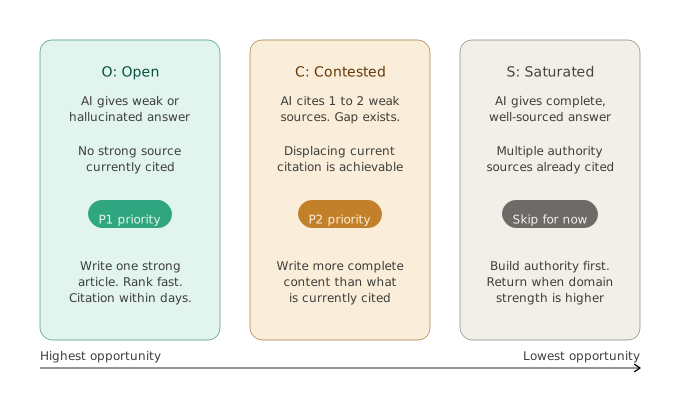
Start instead with Open queries. Find the questions your buyers ask where AI currently gives a vague, generic, or hallucinated answer. Write one well-structured article for that query. Structure every paragraph as a standalone extractable block. Put the direct answer in the first 50 words.
Then build the cluster. Map the sub-queries AI will fanout to when it processes your primary topic. Build assets for each one. Let your citation surface compound across every internal search AI runs.
Ranking used to be the finish line. In AI search, ranking is only the prerequisite. Citation is the competition. The brands that understand that now will be significantly harder to displace in twelve months.